How to crop a PDF
Trim margins and scanner edges off your pages, apply one crop to everything or a different crop per page.
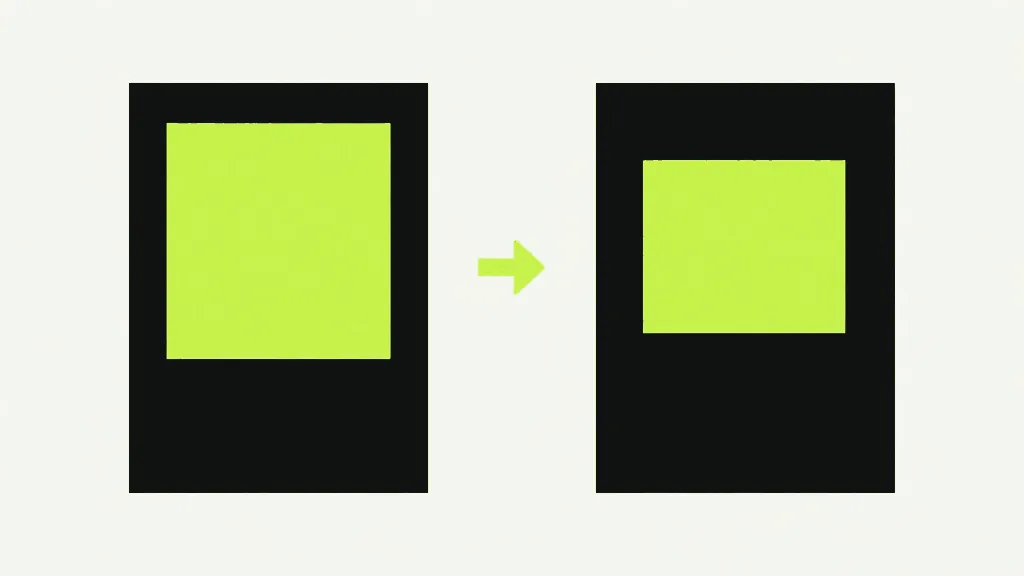
A scan is almost always bigger than the document inside it. The feeder leaves a grey stripe down one edge. The lid did not close, so there is a black border where the room got in. A page photographed on a desk arrives with a centimetre of desk around it. The content is fine — there is just too much page around the content.
Crop a PDF
Upload the PDF
Drop in the file. Every page is rendered as a preview on your own device, which is why a long scan takes a moment to appear before you can do anything.
Choose a mode
On a multi-page document you get two buttons: "Same crop, all pages" or "Crop each page". Pick before you start dragging — they mean genuinely different things.
Drag the rectangle inwards
Pull the handles in to set what you keep. The area outside dims so you can see what you are throwing away. "Reset crop" puts the rectangle back to the full page.
Apply
Click Apply crop. A page whose rectangle still covers the whole page is left exactly as it was, because a full-page crop is not a crop.

Two modes, and picking the wrong one costs you a redo
"Same crop, all pages" takes the one rectangle you dragged and applies it to every page in the document — as a proportion of each page rather than as a fixed measurement. That detail is what makes it survive a mixed document: if one page in the stack was scanned at a different size, the crop still lands in the same relative place instead of sliding off the edge.
"Crop each page" gives every page its own rectangle. You move through the document with the page arrows and drag on whichever page is showing; the label under the preview tells you which page's crop you are currently editing. Nothing is shared between pages, so a fifty-page document can have fifty different crops, or three.
Here is the part worth knowing before you commit. In "Crop each page" mode, a page you never touch is genuinely left alone — not cropped to its own full size, but skipped entirely. That sounds like the same thing and is not. A page can already carry a crop box tighter than its paper size, which is completely normal on anything laid out for print with bleed. Writing a full-page rectangle onto that page would replace the tighter box and reveal the trim area the designer hid. So untouched means untouched: crop three pages out of ninety and the other eighty-seven keep exactly the crop box they arrived with.
What the rectangle will not do
- There is no numeric entry. You cannot type "trim 12mm off the left" — you drag, and you judge it by eye against the preview.
- There are no aspect presets. Nothing locks the box to a square, to 16:9, or to the page ratio. Every corner moves freely.
- The box will not go below about 30 pixels on screen in either direction, so there is a floor on how tight a crop you can drag. On a preview scaled down to fit a phone, those 30 pixels are a much larger slice of the real page than they are on a desktop monitor.
- It crops a rectangle, not a selection. You cannot crop around an object, and there is nothing to snap to.
Rotated pages, and pages that were already cropped
This is the part that quietly goes wrong in crop tools, and it is worth understanding because it explains why your rectangle can land somewhere you never put it. A PDF page has more than one idea of where its edges are. There is the media box, which is the paper, and there is the crop box, which is what a viewer actually shows you — and those are frequently not the same rectangle. Separately, a page can carry a rotation flag telling the viewer to display it turned by ninety degrees while the page underneath stays resolutely portrait.
Both of those break the naive version of a crop. If a tool measures the media box while the preview you dragged on was built from the crop box, your rectangle is applied to a page you were never shown. If a tool ignores the rotation flag, dragging on a landscape preview writes a portrait rectangle, and the trim comes off the wrong two sides.
So this tool takes your rectangle as a fraction of the page as displayed — the exact space your cursor was in — and converts it into PDF coordinates in exactly one place, accounting for the rotation and for the crop box's own origin, which is not always at zero. The practical version: what you dragged is what you get, including on a rotated scan and on a print file with bleed. That is not really a feature, it is the absence of a bug. It is worth stating because the bug is common.
A crop hides; it does not delete
Cropped content is still in the file — the viewer just declines to draw it, and anyone can put it back in seconds. If you are cropping in order to hide something before you send it, read Cropping a PDF is not redaction first, because this tool cannot help you there.
For everything else — margins, scanner edges, desk, the white band under a slide, a page scanned at the wrong paper size — cropping is exactly the right tool and it costs you nothing. It is lossless. No image is re-encoded, no page is redrawn, and the text stays selectable and searchable, because none of it was touched. The file barely changes size, which is the giveaway that nothing happened to the content.
Two last practicalities. Your original is only ever read: the crop lands on the copy that downloads, named after your file with "_cropped" on the end, so a mis-drag costs you a download rather than a document. And a password-protected PDF stops at the preview stage with a message saying so, because the renderer has to actually read the pages to draw them — unlock it first and cropping works normally. Everything happens in your browser; the file is never uploaded.