How to sign a PDF
Draw or type a signature and place it on the page — and where this sits relative to a legally-binding e-signature.
Most documents that need signing do not need a lawyer. A delivery note, an internal approval, a school form, a landlord's inventory: what they need is your mark in the box, and a signature drawn with a mouse is completely adequate for all of it. It is worth being precise about where that stops being true, because the word "signature" covers two very different things.
Sign a PDF
Upload the PDF
Drop in the document. Every page is rendered so you can see where the signature is going.
Draw or type your signature
Draw it on the pad with a mouse, trackpad or finger, or switch to Type and enter your name in a script face. Black or blue ink.
Confirm it
Click Use signature. It is trimmed to its own edges and becomes a transparent image you can place.
Put it where it goes
Drag it into position and resize from the corners — the proportions stay locked so it cannot be stretched. Use the page arrows if it belongs on a different page.
Apply
Click Apply signature. The signature is stamped onto that page and the signed copy downloads.
This is not a legally-binding e-signature
It adds a picture of your signature to the page. That is all it does, and being straight about it is more useful than hedging. There is no identity verification — nothing checks that you are you, and anyone who can open the file can draw the same name. There is no tamper-evident certificate, so nothing in the document records when it was signed or reveals if a page was altered afterwards. There is no audit trail.
A qualified e-signature service does those things, and that is what you are paying it for: it verifies the signer, binds the signature cryptographically to the exact bytes of the document, and can prove afterwards that neither was swapped. If you are signing something where a dispute is imaginable — an employment contract, a property document, anything a court might look at — use one of those. If you are signing a delivery note, this is fine and the alternative is printing, signing and scanning a piece of paper for no reason.
Draw or type
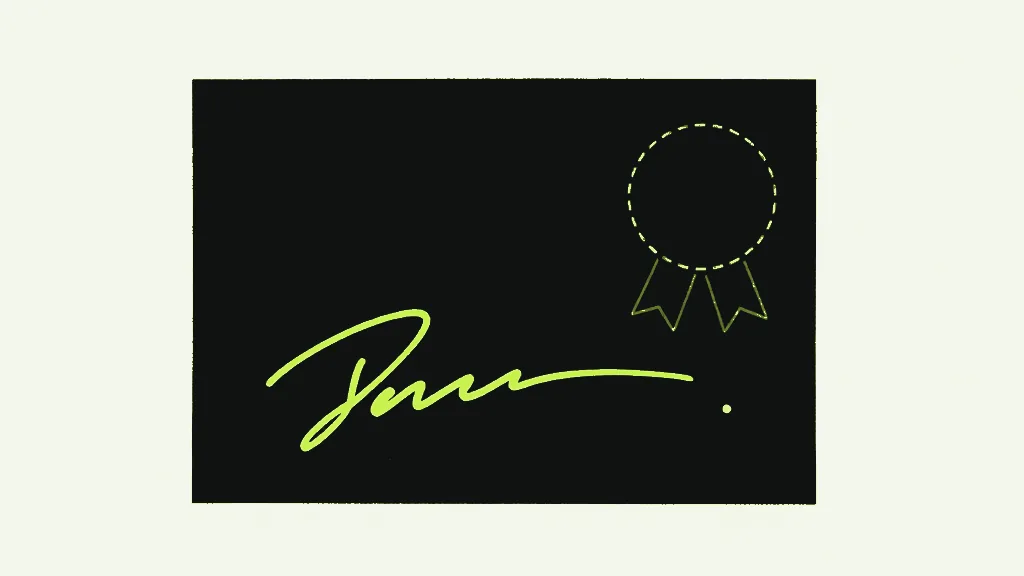
Drawing gives you a pad about 560 by 180 pixels — a wide, short strip, sized like the line you would sign on paper. Ink comes in black or blue and there are no other colours, which is not much of a loss given what a signature is. What you draw is trimmed to its own bounding box, so the empty space around your name does not become empty space around the image when you place it.
Typing renders your name in a script face, and this one has a catch worth knowing. It asks for Segoe Script, then Bradley Hand, then Brush Script MT, then whatever the system calls cursive. Those are Windows and Apple fonts respectively, so the same typed name looks materially different depending on the machine that made it. On most Linux and Android systems none of them resolve and you get a generic cursive fallback that may not be very cursive at all. The preview shows you exactly what you will get, so look at it rather than assuming.
One signature, one page, per pass
Applying places a single signature on a single page. If a contract needs initialling on all three pages, that is three passes: sign page one, download, upload the result, sign page two, and so on. It is tedious and there is no way around it in this tool — worth knowing before you start on a document with a signature block on every sheet rather than discovering it at page two.
Use signature stays greyed out until there is ink on the pad, so an empty pad shows you the button is not ready rather than ignoring the click. A single tap does count as ink — it leaves a dot, which is what you want for a full stop or a dotted i, but it also means a stray click on the pad is a mark you may not have meant. Clear wipes the pad and greys the button out again.
Where it lands and how it sits
- The box starts at 40% of the page width, capped at 240 pixels, sitting 12% up from the bottom — roughly where a signature line lives on most documents.
- Resizing is aspect-locked from the corners, so your signature keeps its proportions and cannot be squashed into a caricature of itself.
- The page is not rasterised. The signature is stamped over the top as a transparent image, so the document's text stays selectable and searchable underneath it.
- Pages that are stored rotated are handled — the signature arrives upright and where you put it, rather than sideways in a corner.
- Your original is untouched; you get a new copy ending in _signed.
Practical advice
Draw rather than type when it matters. A typed name in a script font is obviously a typed name in a script font, and everyone who receives it knows that; a drawn signature at least looks like yours. Drawing with a finger on a phone gives a better result than a mouse on a desktop, for the same reason handwriting works better with a hand than with a brick — signing on an iPhone covers the Markup route and the browser one.
The document and the signature never leave your device — the whole thing runs in the browser tab, which is worth something when the file is a contract. If the document also has real form fields to complete, fill them in first with Fill PDF Forms, then sign the result.